

The Bureau of Labor Statistics has recently released its report “Highlights of Women’s Earnings in 2012.” Stepping past the obvious question as to why women’s issues are visible at all in an institution which (we are led to believe) is in the iron clutches of “patriarchy” (an argument often used to dismiss or marginalize men’s issues), we might also ask how the data in this report bodes for men and boys in the context of education. That is what I will do here.
In particular, let’s look at this graph on page 4 on data on men’s and women’s earnings relative to the degree of educational attainment from 1979-2012:
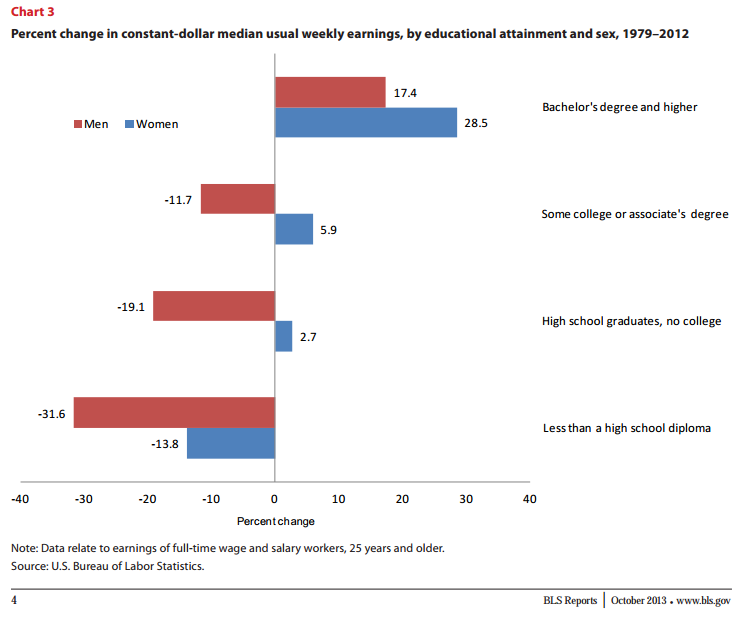 As you can see, the most critical sector of male decline is among those without postsecondary education, both among those who did not enroll in higher education but graduated high school, and those who did not. Women with a high school diploma experienced a gain of 2.7%, whereas men who graduated experienced a 19.1% decline. Among those without a high school diploma, while women’s earnings fell by 13.8%, men’s fell by a staggering 31.6% – nearly three times as much.
This makes sense when you think about it. In my experience, lower education is the sector of education where a transformation in teaching practices is most sorely needed. As Dr. Mary Hendrix, Vice President of Student Success at A&M-Commerce (my alma mater) where males are only half as likely to graduate as females, says in an article in the Dallas Morning News, “it always goes back to, they are not prepared when they get here.”
Furthermore, the majority of high school dropouts are minority males from what education reformists often call “low-income families,” which is a euphemism for what is otherwise politically inconvenient to say: fatherless homes.
What is not revealed by the BLS data – which charts the economic positions of men and women 25 and older – is that many young men from these backgrounds simply cannot hold a job even if it were laid in front of them because they are currently incapacitated by the prison system. As the College Board said in its landmark report “The Educational Experience of Young Men of Color,” by the age of 24 nearly half of young men of color who graduate from high school will end up unemployed, incarcerated or dead.
The critical decline in male earnings among those without postsecondary education is consistent with the explosive growth of the U.S. prison and family court systems. These sectors are tied together with a kind of negative synergy where changes in one area are inevitably felt in another. All of these need to change together before substantial, long-lasting progress can be made.
Thank You for Reading
If you like what you have read, feel free to sign up for our newsletter here:
About the Author
Related Posts


The Bureau of Labor Statistics has recently released its report “Highlights of Women’s Earnings in 2012.” Stepping past the obvious question as to why women’s issues are visible at all in an institution which (we are led to believe) is in the iron clutches of “patriarchy” (an argument often used to dismiss or marginalize men’s issues), we might also ask how the data in this report bodes for men and boys in the context of education. That is what I will do here.
In particular, let’s look at this graph on page 4 on data on men’s and women’s earnings relative to the degree of educational attainment from 1979-2012:
As you can see, the most critical sector of male decline is among those without postsecondary education, both among those who did not enroll in higher education but graduated high school, and those who did not. Women with a high school diploma experienced a gain of 2.7%, whereas men who graduated experienced a 19.1% decline. Among those without a high school diploma, while women’s earnings fell by 13.8%, men’s fell by a staggering 31.6% – nearly three times as much.
This makes sense when you think about it. In my experience, lower education is the sector of education where a transformation in teaching practices is most sorely needed. As Dr. Mary Hendrix, Vice President of Student Success at A&M-Commerce (my alma mater) where males are only half as likely to graduate as females, says in an article in the Dallas Morning News, “it always goes back to, they are not prepared when they get here.”
Furthermore, the majority of high school dropouts are minority males from what education reformists often call “low-income families,” which is a euphemism for what is otherwise politically inconvenient to say: fatherless homes.
What is not revealed by the BLS data – which charts the economic positions of men and women 25 and older – is that many young men from these backgrounds simply cannot hold a job even if it were laid in front of them because they are currently incapacitated by the prison system. As the College Board said in its landmark report “The Educational Experience of Young Men of Color,” by the age of 24 nearly half of young men of color who graduate from high school will end up unemployed, incarcerated or dead.
The critical decline in male earnings among those without postsecondary education is consistent with the explosive growth of the U.S. prison and family court systems. These sectors are tied together with a kind of negative synergy where changes in one area are inevitably felt in another. All of these need to change together before substantial, long-lasting progress can be made.
Thank You for Reading
If you like what you have read, feel free to sign up for our newsletter here:
More from Title IX for All

Advisors for Accused Students
We can help you craft and execute a defense strategy at any stage—from report to investigation to adjudication—with the goal of achieving the best possible outcome.

Accused Students Database
A feature-rich database of lawsuits by accused higher ed students alleging schools violated their rights while investigating sexual misconduct claims.