

Our OCR Resolutions Database – which tracks and provides analytics for resolved Title IX investigations and enforcement measures by the Department of Education’s Office for Civil Rights – has reached over 1,000 cases. After recently loading nearly a dozen resolutions from Trump’s second term, it is now at 1,041. Quite a lot, given that we started at ~230 when it was initially released in September of 2019!
That said, this number should be interpreted as the floor. There are doubtless other resolutions out there that OCR is not ready to make public. Also, many other “inquiries” by OCR have been successful in the sense that OCR dismissed complaints after schools made quick compliance changes, but because they did not result in an official resolution agreement they are not represented here.
Nonetheless, official OCR resolution “letters” and “agreements” present useful insights. We can get a sense of what issues the Department of Education (ED) is prioritizing, which regional OCR offices are shouldering most of the workload, how OCR is interpreting various regulations, and shifting trends in the OCR workforce. Here are a few examples.
Changes During Trump’s Second Term
Less than two months into his second term, Trump wiped out half of OCR’s regional enforcement offices. The Chicago, Philadelphia, New York City, Dallas, San Francisco, Boston, and Cleveland offices are now shuttered. Historically, the distribution of enforcement across regional offices looked like this:
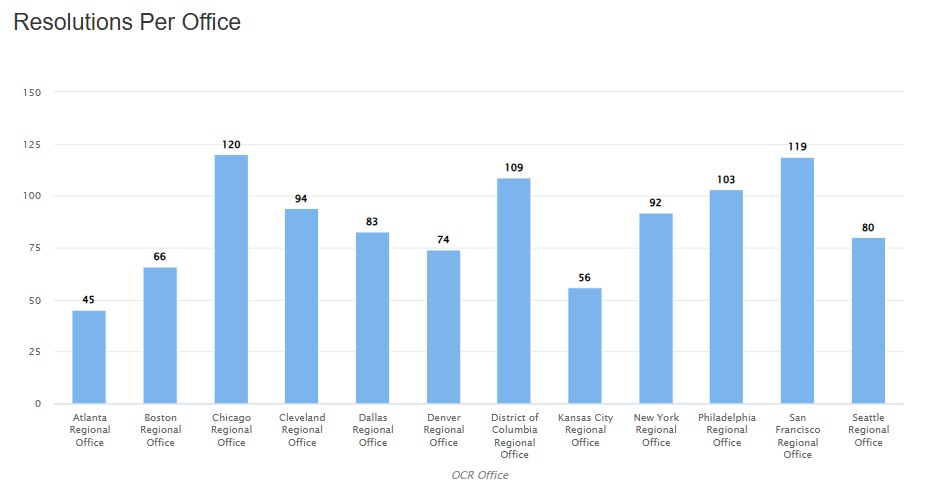
Now, almost all resolved cases appear to be coming out of the Kansas City and DC offices.
When the Window Closed
As anticipated, the Biden administration radically accelerated the closing of investigations leading up to Trump’s inauguration this January. For example, OCR signed 13 resolution agreements in the five days between January 13-17. This is twice the volume of investigations they closed each month during the immediately prior months of November and December of 2024 and during the holiday seasons of Thanksgiving and Christmas.
Trump: Title IX Enforcer in Chief?
Ironically, and despite all the controversy that the Dear Colleague Letter generated in 2011, it is not commonly known that in Trump’s first term produced more Title IX enforcement than either Biden’s term or Obama’s two terms combined – including investigations of schools for insufficiently responding to sexual misconduct. As with most OCR resolutions across all administrations, these were overwhelmingly resolved in favor of complainants.
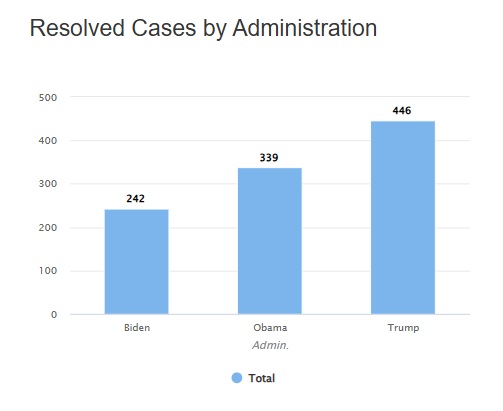
Note: the above figures are from before 1/20/2025.
All things considered, the volume of resolved investigations looks particularly low for the Biden administration, sitting at nearly half of Trump’s and less than Obama’s. While Obama had two terms and Biden had one, Obama’s enforcement of Title IX didn’t get well underway until more than two years into his first term, and a lot of it was mired by enforcing sub-regulatory guidance as though it was regulation. Trump’s 2020 Title IX rule wasn’t in effect until the last five months of his own first term. Biden had much more Title IX regulation that his administration could lawfully enforce, and he could enforce it for the entirety of his term.
While the Biden administration was more interested in the rights of complainants, it’s not like the 2020 regs (which were active during most of Biden’s term) only provided greater rights to accused students; complainants also benefitted from greater opportunities to review and respond to evidence, cross-examine respondents and witnesses, appeal dismissals and determinations, secure an advisor of choice, object to investigators who presented bias or conflicts of interest, and so forth.
To provide an example from a case closed out at the tail end of Biden’s term, OCR investigated an allegation that most of a sexual misconduct complainant’s relevant questions were improperly blocked by a hearing officer during cross-examination. To make matters worse, the university did not preserve a recording or transcript of the live hearing as required by the 2020 regulations, so the complainant did not have the opportunity to properly appeal and OCR could not sufficiently review whether the complainant’s relevant questions were improperly blocked.
While OCR enforcement has been ramping up over the past six months, it is unlikely that Trump’s second term will produce as much Title IX enforcement as his first term given that he has wiped out half of OCR’s enforcement offices and fired many civil rights attorneys employed there. Trump has also promised more than once to close the Department of Education, and while this is possible (though in my view unlikely), all we have seen so far is managed decline of ED and OCR infrastructure.
So…What is OCR Investigating Now?
How schools respond to sexual misconduct, followed by equal opportunities in athletics, have historically been OCR’s two most investigated Title IX issues by a pretty wide margin. This is unlikely to change. Trump’s second term adds the twist of investigating schools for gender identity issues, however.
In a case closed out last month, OCR investigated a college for “allow[ing] allow men to participate on teams designated for women, thereby depriving women of equal athletic opportunities.” Despite the college’s predictable invocation of SCOTUS’ Title VII holdings in Bostock v. Clayton County, OCR found similar to what Judge Danny Reeves found when he vacated the 2024 regulations: that “[its] interpretation of Title VII does not defeat this straightforward reading of Title IX’s text, context, and history.” The college was ordered to amend its athletics policy accordingly. Similar investigations into the California and Maine Departments of Education were closed out in March and June.
What’s Next?
While the future is always uncertain, there are degrees of uncertainty. We can expect that the federal government will continue to investigate schools for Title IX matters. Whether those investigations will be carried out by OCR or some other department (such as the Department of Justice) in the not-too-distant future, how well OCR can handle the workload, what specific issues are prioritized, and so forth, are all up in the air.
At any rate, you can subscribe to our OCR Resolutions Database for information and insights on federal Title IX enforcement – and as always, our Accused Students Database for a library of information on litigation involving accused students.
Thank You for Reading
If you like what you have read, feel free to sign up for our newsletter here:
About the Author
Related Posts


Our OCR Resolutions Database – which tracks and provides analytics for resolved Title IX investigations and enforcement measures by the Department of Education’s Office for Civil Rights – has reached over 1,000 cases. After recently loading nearly a dozen resolutions from Trump’s second term, it is now at 1,041. Quite a lot, given that we started at ~230 when it was initially released in September of 2019!
That said, this number should be interpreted as the floor. There are doubtless other resolutions out there that OCR is not ready to make public. Also, many other “inquiries” by OCR have been successful in the sense that OCR dismissed complaints after schools made quick compliance changes, but because they did not result in an official resolution agreement they are not represented here.
Nonetheless, official OCR resolution “letters” and “agreements” present useful insights. We can get a sense of what issues the Department of Education (ED) is prioritizing, which regional OCR offices are shouldering most of the workload, how OCR is interpreting various regulations, and shifting trends in the OCR workforce. Here are a few examples.
Changes During Trump’s Second Term
Less than two months into his second term, Trump wiped out half of OCR’s regional enforcement offices. The Chicago, Philadelphia, New York City, Dallas, San Francisco, Boston, and Cleveland offices are now shuttered. Historically, the distribution of enforcement across regional offices looked like this:
Now, almost all resolved cases appear to be coming out of the Kansas City and DC offices.
When the Window Closed
As anticipated, the Biden administration radically accelerated the closing of investigations leading up to Trump’s inauguration this January. For example, OCR signed 13 resolution agreements in the five days between January 13-17. This is twice the volume of investigations they closed each month during the immediately prior months of November and December of 2024 and during the holiday seasons of Thanksgiving and Christmas.
Trump: Title IX Enforcer in Chief?
Ironically, and despite all the controversy that the Dear Colleague Letter generated in 2011, it is not commonly known that in Trump’s first term produced more Title IX enforcement than either Biden’s term or Obama’s two terms combined – including investigations of schools for insufficiently responding to sexual misconduct. As with most OCR resolutions across all administrations, these were overwhelmingly resolved in favor of complainants.
Note: the above figures are from before 1/20/2025.
All things considered, the volume of resolved investigations looks particularly low for the Biden administration, sitting at nearly half of Trump’s and less than Obama’s. While Obama had two terms and Biden had one, Obama’s enforcement of Title IX didn’t get well underway until more than two years into his first term, and a lot of it was mired by enforcing sub-regulatory guidance as though it was regulation. Trump’s 2020 Title IX rule wasn’t in effect until the last five months of his own first term. Biden had much more Title IX regulation that his administration could lawfully enforce, and he could enforce it for the entirety of his term.
While the Biden administration was more interested in the rights of complainants, it’s not like the 2020 regs (which were active during most of Biden’s term) only provided greater rights to accused students; complainants also benefitted from greater opportunities to review and respond to evidence, cross-examine respondents and witnesses, appeal dismissals and determinations, secure an advisor of choice, object to investigators who presented bias or conflicts of interest, and so forth.
To provide an example from a case closed out at the tail end of Biden’s term, OCR investigated an allegation that most of a sexual misconduct complainant’s relevant questions were improperly blocked by a hearing officer during cross-examination. To make matters worse, the university did not preserve a recording or transcript of the live hearing as required by the 2020 regulations, so the complainant did not have the opportunity to properly appeal and OCR could not sufficiently review whether the complainant’s relevant questions were improperly blocked.
While OCR enforcement has been ramping up over the past six months, it is unlikely that Trump’s second term will produce as much Title IX enforcement as his first term given that he has wiped out half of OCR’s enforcement offices and fired many civil rights attorneys employed there. Trump has also promised more than once to close the Department of Education, and while this is possible (though in my view unlikely), all we have seen so far is managed decline of ED and OCR infrastructure.
So…What is OCR Investigating Now?
How schools respond to sexual misconduct, followed by equal opportunities in athletics, have historically been OCR’s two most investigated Title IX issues by a pretty wide margin. This is unlikely to change. Trump’s second term adds the twist of investigating schools for gender identity issues, however.
In a case closed out last month, OCR investigated a college for “allow[ing] allow men to participate on teams designated for women, thereby depriving women of equal athletic opportunities.” Despite the college’s predictable invocation of SCOTUS’ Title VII holdings in Bostock v. Clayton County, OCR found similar to what Judge Danny Reeves found when he vacated the 2024 regulations: that “[its] interpretation of Title VII does not defeat this straightforward reading of Title IX’s text, context, and history.” The college was ordered to amend its athletics policy accordingly. Similar investigations into the California and Maine Departments of Education were closed out in March and June.
What’s Next?
While the future is always uncertain, there are degrees of uncertainty. We can expect that the federal government will continue to investigate schools for Title IX matters. Whether those investigations will be carried out by OCR or some other department (such as the Department of Justice) in the not-too-distant future, how well OCR can handle the workload, what specific issues are prioritized, and so forth, are all up in the air.
At any rate, you can subscribe to our OCR Resolutions Database for information and insights on federal Title IX enforcement – and as always, our Accused Students Database for a library of information on litigation involving accused students.
Thank You for Reading
If you like what you have read, feel free to sign up for our newsletter here:
About the Author
Related Posts
More from Title IX for All

Accused Students Database
Research due process and similar lawsuits by students accused of Title IX violations (sexual assault, harassment, dating violence, stalking, etc.) in higher education.

OCR Resolutions Database
Research resolved Title IX investigations of K-12 and postsecondary institutions by the Department of Education’s Office for Civil Rights (OCR).
