And some Feminists are all a-twitter about it. Literally.
RAINN (the Rape, Abuse, & Incest National Network), which describes itself as the nation’s largest anti-violence organization, has thrown its hat in the ring regarding Feminist politics and sex-assault victims in higher education. In their letter to the recently-formed White House task force designed to protect students from sexual assault, they say:
In the last few years, there has been an unfortunate trend towards blaming “rape culture” for the extensive problem of sexual violence on campuses. While it is helpful to point out the systemic barriers to addressing the problem, it is important to not lose sight of a simple fact: Rape is caused not by cultural factors but by the conscious decisions, of a small percentage of the community, to commit a violent crime. While that may seem an obvious point, it has tended to get lost in recent debates.
Which is exactly what men’s advocates and sensible everyday folk have been saying for years. RAINN continues:
This has led to an inclination to focus on particular segments of the student population (e.g., athletes), particular aspects of campus culture (e.g., the Greek system), or traits that are common in many millions of law-abiding Americans (e.g., “masculinity”), rather than on the subpopulation at fault: those who choose to commit rape. This trend has the paradoxical effect of making it harder to stop sexual violence, since it removes the focus from the individual at fault, and seemingly mitigates personal responsibility for his or her own actions.
It should be obvious to everyone (except for Feminists) that anyone who acts in the slightest bit masculine is not necessarily a rapist in waiting. But listening to the way a lot of Feminists talk, and the way a lot of Feminists present themselves, you would think that most men support raping women with wild abandon.
The authors of the website Community of the Wrongly Accused had this to say on the matter:
Rape is not caused by “rape culture” or masculinity. It’s caused by sociopaths who rape. To assert that doesn’t lessen the harm to rape victims, it simply makes clear that “redefining masculinity” is not the solution.
Feminists have launched a scorched-earth campaign against men and boys in academia regarding sexual assault. Any place where men gather among only men – frat houses, athletic teams, and so forth – are regarded as rape-enabling spaces. Of course, women-only spaces are not regarded by Feminists as spaces that enable false rape accusations.
Funny how that works.
That is why there has been a campaign to close down numerous campus fraternities, sometimes because of the actions of a singular frat member, and sometimes based on nothing more than an accusation. And we should all remember how, during the infamous 2006 Duke lacrosse false rape case, Duke University suspended the team and fired the coach immediately after three lacrosse players were falsely accused of rape.
Questioning the “rape culture” narrative of Feminism defeats the Feminist war on male space: the war on male solidarity, and male friendship. There is nothing inherently wrong with men gathering among men, or women gathering among women. But when the former is viewed as inherently evil and the latter is viewed as not only good but also necessary, that’s a morally problematic worldview. And that worldview is owed directly to the hateful beliefs of Feminism.
Jessica Valenti, author of the iconic modern Feminist book Full Frontal Feminism, had this to say:
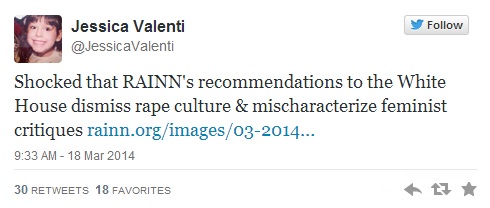
Newsflash: RAINN did not “dismiss” the flawed notions of “rape culture.” They deconstructed it.
And more:
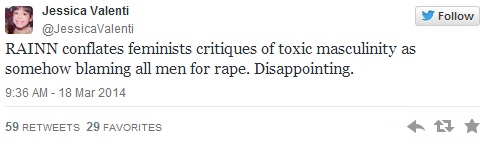
Incorrect. And I’ll just go ahead and say it: Valenti is lying.
It’s typical of Feminists to strawman their opponents’ arguments. They simply can’t hold any ground in an “argument” without lying about their opposition. You see, you don’t have to blame “all men” for rape in order to blame the vast majority of men for it. And that is exactly what Feminists do.
One of Feminism’s more common intellectual vices is its tendency to overgeneralize about problems, and overgeneralize about the evil of men. I’ve said it before and I’ll say it again: the degree to which activists generalize about problems matters. Feminism cherry-picks disadvantages from only the female side of the equation, and then embellishes and blows them out of proportion.
We see this tendency among Feminists all the time. If one man at the top of society sends ten thousand men at the bottom to die in war, Feminists will ignore the suffering of the ten thousand men at the bottom to complain about the privilege of the one man at the top. They will then act as though women are “disproportionately singled out and disadvantaged” because women were not equally represented among the very small number of men who sent huge numbers of men to a horrible death.
I actually think there is a problem with rape-supportive attitudes and assumptions in society. But where I differ with Feminists is that I do not believe that they are “normalized” in society. I do not overgeneralize about it. Our culture, in general, does not support rape. If Feminists had instead called it a rape subculture, it would have made a lot more sense to me. I would probably even call it accurate.
But when they walk around saying “we live in a rape culture,” as if our culture generally supports rape, I won’t have any supportive or kind words for them. Nor should anyone.
A movement cannot sustain itself forever on hyperbole, gimmicks, clichés, slogans, hot air, and whatnot. It actually needs an intellectual foundation. Otherwise it’s just a hysteria, a craze, a political fad. And when it comes to sexual assault on campus, that’s pretty much what Feminism is.
And as RAINN has so eloquently demonstrated, it’s starting to come back to bite them. It was only a matter of time, of course.
Valenti isn’t done yet, however:
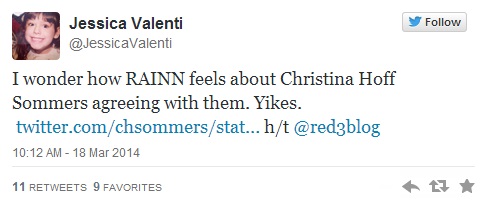
I have a better question: how do Feminists like Jessica Valenti feel about organizations like RAINN – the largest antiviolence organization on planet earth – disagreeing with them?
Oh, but we already know how they feel: they are shocked! Shocked, I tell you.
But perhaps Feminists are just misunderstood. Why can’t organizations like RAINN understand that Feminists like Valenti just want to defend women from male violence? Does that really sound so unreasonable? But switch out the sexes with the races, and they would be like the white nationalists who wring their hands and wonder why people criticize their efforts to protect “proper white folk” from black violence.
We need to be careful when we start talking about protecting “this group” from “that group,” especially in the context of violence. Feminists have clearly failed in that regard. It’s long past time for their betters to lead the way.
The narrative of Feminism is not only anti-male, it just isn’t accurate enough to help victims of sexual assault, and sometimes actively works against them. Three cheers for RAINN in taking a sensible approach to addressing sexual assault on campus.
Thank You for Reading
If you like what you have read, feel free to sign up for our newsletter here:
About the Author
Related Posts


And some Feminists are all a-twitter about it. Literally.
RAINN (the Rape, Abuse, & Incest National Network), which describes itself as the nation’s largest anti-violence organization, has thrown its hat in the ring regarding Feminist politics and sex-assault victims in higher education. In their letter to the recently-formed White House task force designed to protect students from sexual assault, they say:
In the last few years, there has been an unfortunate trend towards blaming “rape culture” for the extensive problem of sexual violence on campuses. While it is helpful to point out the systemic barriers to addressing the problem, it is important to not lose sight of a simple fact: Rape is caused not by cultural factors but by the conscious decisions, of a small percentage of the community, to commit a violent crime. While that may seem an obvious point, it has tended to get lost in recent debates.
Which is exactly what men’s advocates and sensible everyday folk have been saying for years. RAINN continues:
This has led to an inclination to focus on particular segments of the student population (e.g., athletes), particular aspects of campus culture (e.g., the Greek system), or traits that are common in many millions of law-abiding Americans (e.g., “masculinity”), rather than on the subpopulation at fault: those who choose to commit rape. This trend has the paradoxical effect of making it harder to stop sexual violence, since it removes the focus from the individual at fault, and seemingly mitigates personal responsibility for his or her own actions.
It should be obvious to everyone (except for Feminists) that anyone who acts in the slightest bit masculine is not necessarily a rapist in waiting. But listening to the way a lot of Feminists talk, and the way a lot of Feminists present themselves, you would think that most men support raping women with wild abandon.
The authors of the website Community of the Wrongly Accused had this to say on the matter:
Rape is not caused by “rape culture” or masculinity. It’s caused by sociopaths who rape. To assert that doesn’t lessen the harm to rape victims, it simply makes clear that “redefining masculinity” is not the solution.
Feminists have launched a scorched-earth campaign against men and boys in academia regarding sexual assault. Any place where men gather among only men – frat houses, athletic teams, and so forth – are regarded as rape-enabling spaces. Of course, women-only spaces are not regarded by Feminists as spaces that enable false rape accusations.
Funny how that works.
That is why there has been a campaign to close down numerous campus fraternities, sometimes because of the actions of a singular frat member, and sometimes based on nothing more than an accusation. And we should all remember how, during the infamous 2006 Duke lacrosse false rape case, Duke University suspended the team and fired the coach immediately after three lacrosse players were falsely accused of rape.
Questioning the “rape culture” narrative of Feminism defeats the Feminist war on male space: the war on male solidarity, and male friendship. There is nothing inherently wrong with men gathering among men, or women gathering among women. But when the former is viewed as inherently evil and the latter is viewed as not only good but also necessary, that’s a morally problematic worldview. And that worldview is owed directly to the hateful beliefs of Feminism.
Jessica Valenti, author of the iconic modern Feminist book Full Frontal Feminism, had this to say:
Newsflash: RAINN did not “dismiss” the flawed notions of “rape culture.” They deconstructed it.
And more:
Incorrect. And I’ll just go ahead and say it: Valenti is lying.
It’s typical of Feminists to strawman their opponents’ arguments. They simply can’t hold any ground in an “argument” without lying about their opposition. You see, you don’t have to blame “all men” for rape in order to blame the vast majority of men for it. And that is exactly what Feminists do.
One of Feminism’s more common intellectual vices is its tendency to overgeneralize about problems, and overgeneralize about the evil of men. I’ve said it before and I’ll say it again: the degree to which activists generalize about problems matters. Feminism cherry-picks disadvantages from only the female side of the equation, and then embellishes and blows them out of proportion.
We see this tendency among Feminists all the time. If one man at the top of society sends ten thousand men at the bottom to die in war, Feminists will ignore the suffering of the ten thousand men at the bottom to complain about the privilege of the one man at the top. They will then act as though women are “disproportionately singled out and disadvantaged” because women were not equally represented among the very small number of men who sent huge numbers of men to a horrible death.
I actually think there is a problem with rape-supportive attitudes and assumptions in society. But where I differ with Feminists is that I do not believe that they are “normalized” in society. I do not overgeneralize about it. Our culture, in general, does not support rape. If Feminists had instead called it a rape subculture, it would have made a lot more sense to me. I would probably even call it accurate.
But when they walk around saying “we live in a rape culture,” as if our culture generally supports rape, I won’t have any supportive or kind words for them. Nor should anyone.
A movement cannot sustain itself forever on hyperbole, gimmicks, clichés, slogans, hot air, and whatnot. It actually needs an intellectual foundation. Otherwise it’s just a hysteria, a craze, a political fad. And when it comes to sexual assault on campus, that’s pretty much what Feminism is.
And as RAINN has so eloquently demonstrated, it’s starting to come back to bite them. It was only a matter of time, of course.
Valenti isn’t done yet, however:
I have a better question: how do Feminists like Jessica Valenti feel about organizations like RAINN – the largest antiviolence organization on planet earth – disagreeing with them?
Oh, but we already know how they feel: they are shocked! Shocked, I tell you.
But perhaps Feminists are just misunderstood. Why can’t organizations like RAINN understand that Feminists like Valenti just want to defend women from male violence? Does that really sound so unreasonable? But switch out the sexes with the races, and they would be like the white nationalists who wring their hands and wonder why people criticize their efforts to protect “proper white folk” from black violence.
We need to be careful when we start talking about protecting “this group” from “that group,” especially in the context of violence. Feminists have clearly failed in that regard. It’s long past time for their betters to lead the way.
The narrative of Feminism is not only anti-male, it just isn’t accurate enough to help victims of sexual assault, and sometimes actively works against them. Three cheers for RAINN in taking a sensible approach to addressing sexual assault on campus.
Thank You for Reading
If you like what you have read, feel free to sign up for our newsletter here:
More from Title IX for All

Advisors for Accused Students
We can help you craft and execute a defense strategy at any stage—from report to investigation to adjudication—with the goal of achieving the best possible outcome.

Accused Students Database
A feature-rich database of lawsuits by accused higher ed students alleging schools violated their rights while investigating sexual misconduct claims.