
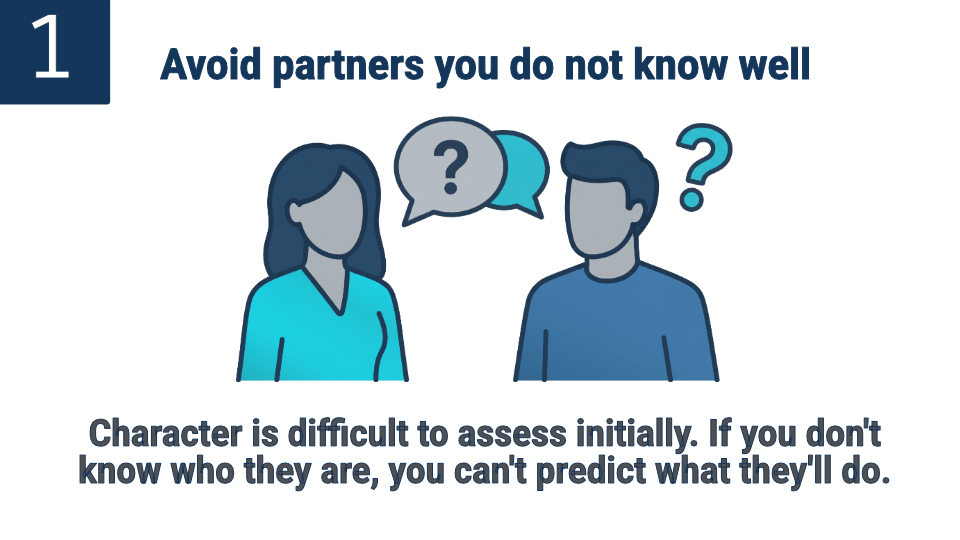
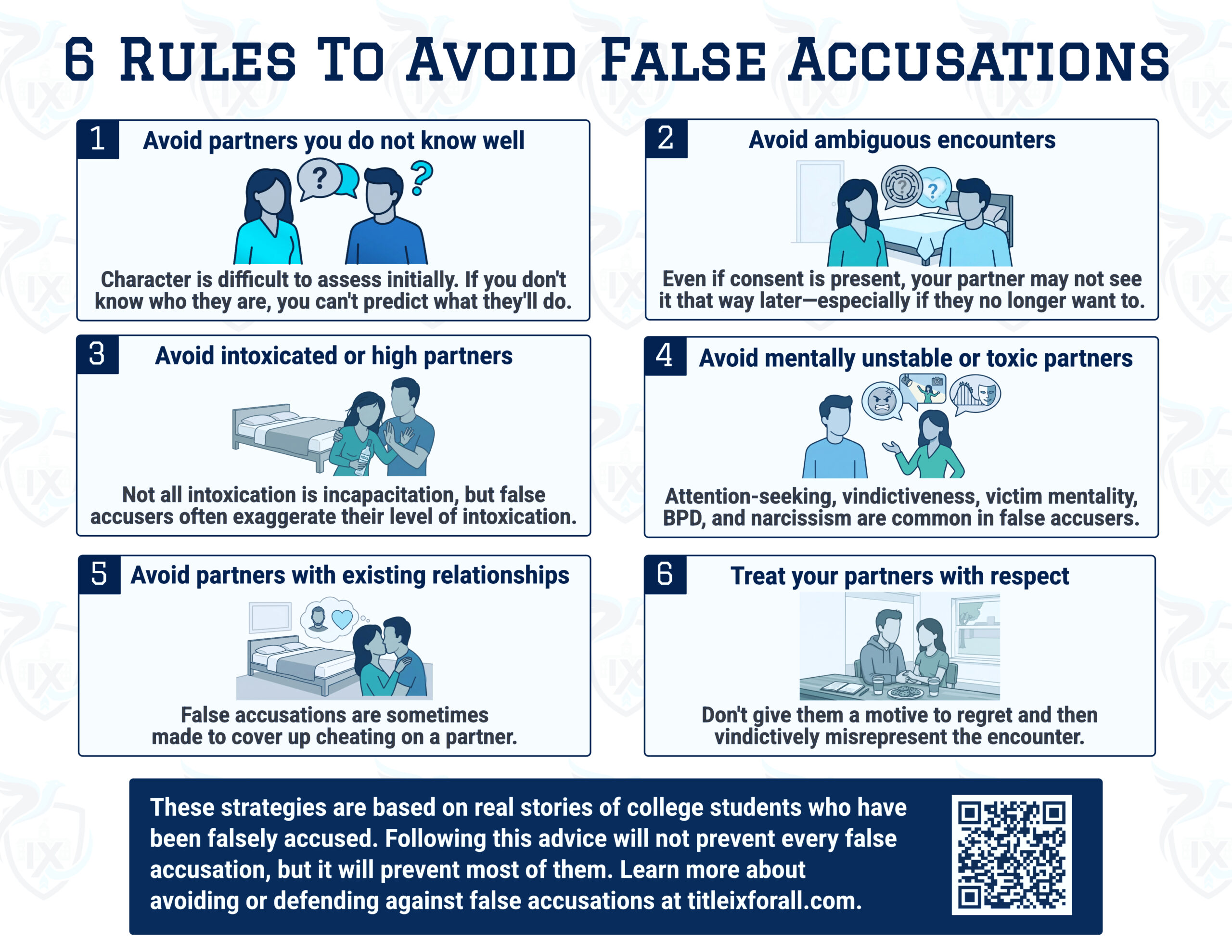
I have just completed this visual and added it to our recently revised guide “Six Rules for Avoiding False Accusations of Sexual Assault.” It is available in both image and PDF form. While following these six rules will greatly reduce the likelihood of being wrongly accused, you will see that much of it is also simple, healthy relationship advice that benefits everyone. Feel free to redistribute it, and feel free to adapt its approach and content to any education you may provide to students college-age or younger.
Good cause exists to distribute this graphic broadly, especially in a way adolescents are likely to notice and consider it. Historically, scant education has taught adolescents—especially young men who need it most—how to protect themselves from wrongful accusations by avoiding the situations and individuals most likely to produce them. Educational institutions do not teach them; consent education only teaches how to reduce the occurrence of sexual misconduct.
Despite their positions of influence, religious institutions and many parents also tend not to teach those under their care how to avoid false accusations. Consequently, young men tend to be raised in a fog of naïveté and lack the instincts to avoid dangerous situations. For too many, real-world experience then provides harsh lessons. It is no wonder these men later find affirmation of their experiences in the online world and reject the authority of “experts” who tell them to ignore the evidence of their eyes and ears.
Society has a responsibility to protect youth—especially young men who are most at risk—from wrongful accusations. Because it has largely abandoned that responsibility, much avoidable harm has been done, and the moral standard-bearers for the youth have forfeited young men as an audience to less responsible online influencers. The good news is that opportunity exists to correct it in behalf of future generations, if we have the courage and humility to try.
Thank You for Reading
If you like what you have read, feel free to sign up for our newsletter here:
About the Author
Related Posts



I have just completed this visual and added it to our recently revised guide “Six Rules for Avoiding False Accusations of Sexual Assault.” It is available in both image and PDF form. While following these six rules will greatly reduce the likelihood of being wrongly accused, you will see that much of it is also simple, healthy relationship advice that benefits everyone. Feel free to redistribute it, and feel free to adapt its approach and content to any education you may provide to students college-age or younger.
Good cause exists to distribute this graphic broadly, especially in a way adolescents are likely to notice and consider it. Historically, scant education has taught adolescents—especially young men who need it most—how to protect themselves from wrongful accusations by avoiding the situations and individuals most likely to produce them. Educational institutions do not teach them; consent education only teaches how to reduce the occurrence of sexual misconduct.
Despite their positions of influence, religious institutions and many parents also tend not to teach those under their care how to avoid false accusations. Consequently, young men tend to be raised in a fog of naïveté and lack the instincts to avoid dangerous situations. For too many, real-world experience then provides harsh lessons. It is no wonder these men later find affirmation of their experiences in the online world and reject the authority of “experts” who tell them to ignore the evidence of their eyes and ears.
Society has a responsibility to protect youth—especially young men who are most at risk—from wrongful accusations. Because it has largely abandoned that responsibility, much avoidable harm has been done, and the moral standard-bearers for the youth have forfeited young men as an audience to less responsible online influencers. The good news is that opportunity exists to correct it in behalf of future generations, if we have the courage and humility to try.
Thank You for Reading
If you like what you have read, feel free to sign up for our newsletter here:
More from Title IX for All

Advisors for Accused Students
We can help you craft and execute a defense strategy at any stage—from report to investigation to adjudication—with the goal of achieving the best possible outcome.

Accused Students Database
A feature-rich database of lawsuits by accused higher ed students alleging schools violated their rights while investigating sexual misconduct claims.