This article from Times Higher Education yields more evidence that men’s issues have reached the ears of upper-level education officials in Britain (see this earlier AVFMS article for more examples of this phenomenon). The Universities and Colleges Admissions Service (UCAS) is an organization which British students must go through when applying for admission into higher education. Its chief executive, Mary Curnock Cook, had some bold words for university administrators earlier this month:
[su_quote]Men should be encouraged into female-dominated subjects such as nursing, teaching and social work, just as science and engineering is promoted to women, the head of UCAS has argued. Mary Curnock Cook pointed out that although women were outnumbered in subjects such as computer science, the gender discrepancy was actually greater in nursing, for example.‘We hear all these things about [getting] more women into science, and women doing physics, and computers and so on,’ she told the annual conference of the Association of University Administrators in Manchester on 15 April. But she asked: ‘Why don’t we hear more about getting men into nursing and education and social work where, after all, there’s a very ready supply of a very large volume of jobs?'[/su_quote]
Indeed. Nursing, despite being a profession full of drama and stress, is still a rather solid field in terms of job security and pay. Simply put, the sick and terminally ill are always going to be present in society. And we will always need medical professionals of all kinds to tend to them.
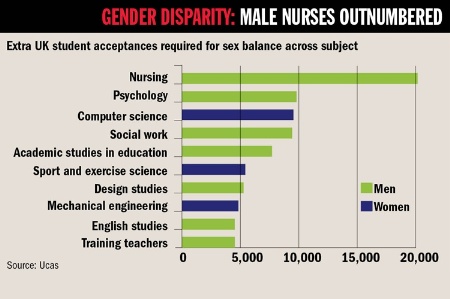
The article provides us with this graph, courtesy of UCAS, which shows that while women are indeed underrepresented in STEM fields (Science/Technology/Engineering/Math), the ratio favoring women in nursing is several times the ratio favoring men in STEM:
The article continues:
[su_quote]In all types of engineering, it would take just over 15,000 extra female students to balance out the current male dominance of the subject, she said. But in subjects allied to medicine, which includes nursing, the number of extra men needed was close to 30,000.
Yet action over gender imbalances at university was [only] “about women who are disadvantaged compared with men”, she said. “Why wouldn’t you set out to make it more socially acceptable for young men to go into nursing and teaching?” she asked. [/su_quote]
Yes, that’s a very good question. And it speaks to the perversion of the modern “diversity” movement. You see, moving women into areas where men are overrepresented sounds fine – so long as you’re making room for men to move into areas where women are overrepresented as well. And so long as you are being encouraging toward both sexes during this transition, rather than just encouraging one sex and looking down upon the other.
But if all you’re doing is kicking one group out, providing them nowhere to go, and essentially telling them to go die in an alley somewhere, ethical questions begin to emerge. For one thing, is this truly a model premised upon the values of diversity? Or is it instead representative of selective diversity? And if it’s selective diversity, is it really diversity to begin with? Are values really values if we only apply them when they work in our favor, or only in the favor of people we care about?
Also, there questions of practicality. One might wonder how such a model would be sustainable over the long term. One might also wonder how it would help men empathize with and support “empowered women” when such women so often see equality as a one-way street that should always work in their favor. And such a model probably doesn’t work wonders for the economy, or women who desire economically stable partners, either.
No, far from being progressive and equitable, it’s really quite petty, vindictive, and asinine when you think about it. But that’s how a lot of people (in academia especially) see the world. To them, that’s “social justice.”
By the way, in case you’re new or haven’t seen me explain this before, I use words like “diversity” and “social justice” in scare quotes not because I disagree with the terms (let alone those values). On the contrary, I very much support them – on those occasions when I observe them in their true form.
No, I use scare quotes to emphasize my disagreement with how a generation of pretenders have perverted those values into their polar opposites while at the same time still claiming moral and institutional authority over those who have not. People like Mary Cook are the ones advocating true diversity (notice I didn’t use scare quotes there). And although she is speaking the truth, the likelihood is rather high that she is not speaking to the choir.
She continues:
[su_quote]“Maybe some of the issues we’ve got with male education would be improved by having more male primary and secondary teachers,” Ms Curnock Cook said. She added that boys being taught English literature in classes with a majority of girls and by female teachers “doesn’t always make for young men who love English literature”. “I don’t see anything happening in education policy to tackle this issue,” she said. [/su_quote]
Yes, yes, and more yeses. Ms. Cook is bravely spearheading a conversation that should have taken place decades ago.
It’s time to shake off this nonsense idea that equality is a one way street, and the politics of two wrongs make a right. If you think the proper path to educational equity involves ignoring half the human race, you really don’t belong in education. Too many people in academia do, however. That’s why someone needs to get in there and shake things up.
And it appears Mary Cook is doing just that.
Thank you, Ms. Cook.
Thank You for Reading
If you like what you have read, feel free to sign up for our newsletter here:
About the Author
Related Posts


This article from Times Higher Education yields more evidence that men’s issues have reached the ears of upper-level education officials in Britain (see this earlier AVFMS article for more examples of this phenomenon). The Universities and Colleges Admissions Service (UCAS) is an organization which British students must go through when applying for admission into higher education. Its chief executive, Mary Curnock Cook, had some bold words for university administrators earlier this month:
[su_quote]Men should be encouraged into female-dominated subjects such as nursing, teaching and social work, just as science and engineering is promoted to women, the head of UCAS has argued. Mary Curnock Cook pointed out that although women were outnumbered in subjects such as computer science, the gender discrepancy was actually greater in nursing, for example.‘We hear all these things about [getting] more women into science, and women doing physics, and computers and so on,’ she told the annual conference of the Association of University Administrators in Manchester on 15 April. But she asked: ‘Why don’t we hear more about getting men into nursing and education and social work where, after all, there’s a very ready supply of a very large volume of jobs?'[/su_quote]
Indeed. Nursing, despite being a profession full of drama and stress, is still a rather solid field in terms of job security and pay. Simply put, the sick and terminally ill are always going to be present in society. And we will always need medical professionals of all kinds to tend to them.
The article provides us with this graph, courtesy of UCAS, which shows that while women are indeed underrepresented in STEM fields (Science/Technology/Engineering/Math), the ratio favoring women in nursing is several times the ratio favoring men in STEM:
The article continues:
[su_quote]In all types of engineering, it would take just over 15,000 extra female students to balance out the current male dominance of the subject, she said. But in subjects allied to medicine, which includes nursing, the number of extra men needed was close to 30,000.
Yet action over gender imbalances at university was [only] “about women who are disadvantaged compared with men”, she said. “Why wouldn’t you set out to make it more socially acceptable for young men to go into nursing and teaching?” she asked. [/su_quote]
Yes, that’s a very good question. And it speaks to the perversion of the modern “diversity” movement. You see, moving women into areas where men are overrepresented sounds fine – so long as you’re making room for men to move into areas where women are overrepresented as well. And so long as you are being encouraging toward both sexes during this transition, rather than just encouraging one sex and looking down upon the other.
But if all you’re doing is kicking one group out, providing them nowhere to go, and essentially telling them to go die in an alley somewhere, ethical questions begin to emerge. For one thing, is this truly a model premised upon the values of diversity? Or is it instead representative of selective diversity? And if it’s selective diversity, is it really diversity to begin with? Are values really values if we only apply them when they work in our favor, or only in the favor of people we care about?
Also, there questions of practicality. One might wonder how such a model would be sustainable over the long term. One might also wonder how it would help men empathize with and support “empowered women” when such women so often see equality as a one-way street that should always work in their favor. And such a model probably doesn’t work wonders for the economy, or women who desire economically stable partners, either.
No, far from being progressive and equitable, it’s really quite petty, vindictive, and asinine when you think about it. But that’s how a lot of people (in academia especially) see the world. To them, that’s “social justice.”
By the way, in case you’re new or haven’t seen me explain this before, I use words like “diversity” and “social justice” in scare quotes not because I disagree with the terms (let alone those values). On the contrary, I very much support them – on those occasions when I observe them in their true form.
No, I use scare quotes to emphasize my disagreement with how a generation of pretenders have perverted those values into their polar opposites while at the same time still claiming moral and institutional authority over those who have not. People like Mary Cook are the ones advocating true diversity (notice I didn’t use scare quotes there). And although she is speaking the truth, the likelihood is rather high that she is not speaking to the choir.
She continues:
[su_quote]“Maybe some of the issues we’ve got with male education would be improved by having more male primary and secondary teachers,” Ms Curnock Cook said. She added that boys being taught English literature in classes with a majority of girls and by female teachers “doesn’t always make for young men who love English literature”. “I don’t see anything happening in education policy to tackle this issue,” she said. [/su_quote]
Yes, yes, and more yeses. Ms. Cook is bravely spearheading a conversation that should have taken place decades ago.
It’s time to shake off this nonsense idea that equality is a one way street, and the politics of two wrongs make a right. If you think the proper path to educational equity involves ignoring half the human race, you really don’t belong in education. Too many people in academia do, however. That’s why someone needs to get in there and shake things up.
And it appears Mary Cook is doing just that.
Thank you, Ms. Cook.
Thank You for Reading
If you like what you have read, feel free to sign up for our newsletter here:
More from Title IX for All

Advisors for Accused Students
We can help you craft and execute a defense strategy at any stage—from report to investigation to adjudication—with the goal of achieving the best possible outcome.

Accused Students Database
A feature-rich database of lawsuits by accused higher ed students alleging schools violated their rights while investigating sexual misconduct claims.